The candid product thesis: Ambient Desktop becomes the workstation for agentic work on the Ambient Network. It starts with high-value developer work and grows into the official workstation for the Ambient Network.
Ambient Desktop North Star diagram. The Ambient Desktop hub grows into the official workstation for the Ambient Network across four surfaces: Agentic Desktop (coding, workflows, browser evidence; Project Board and durable goals; stable tools plus preview workflows), Ambient Network Client (wallet, balances, programs; Tool Oracle and x402 direction; first-party blockchain workbench), Ambient Mini Miner (opt-in local model mining; llama.cpp runtime foundation; earn network rewards), and Curated Capability Storefront (reviewed Web2/Web3 capabilities; MCP, CLI, and Pi packages; permissioned install paths), all on one Vertically Integrated Routing Fabric spanning local models, Ambient cloud, Ambient Mini, plugins, browser providers, and network operations.
The four surfaces below sit at different points on that arc:
| Surface | State |
|---|---|
| Agentic Desktop | Current and preview |
| Ambient Network Client | In development |
| Ambient Mini Miner | Roadmap |
| Curated Capability Storefront | Marketplace direction |
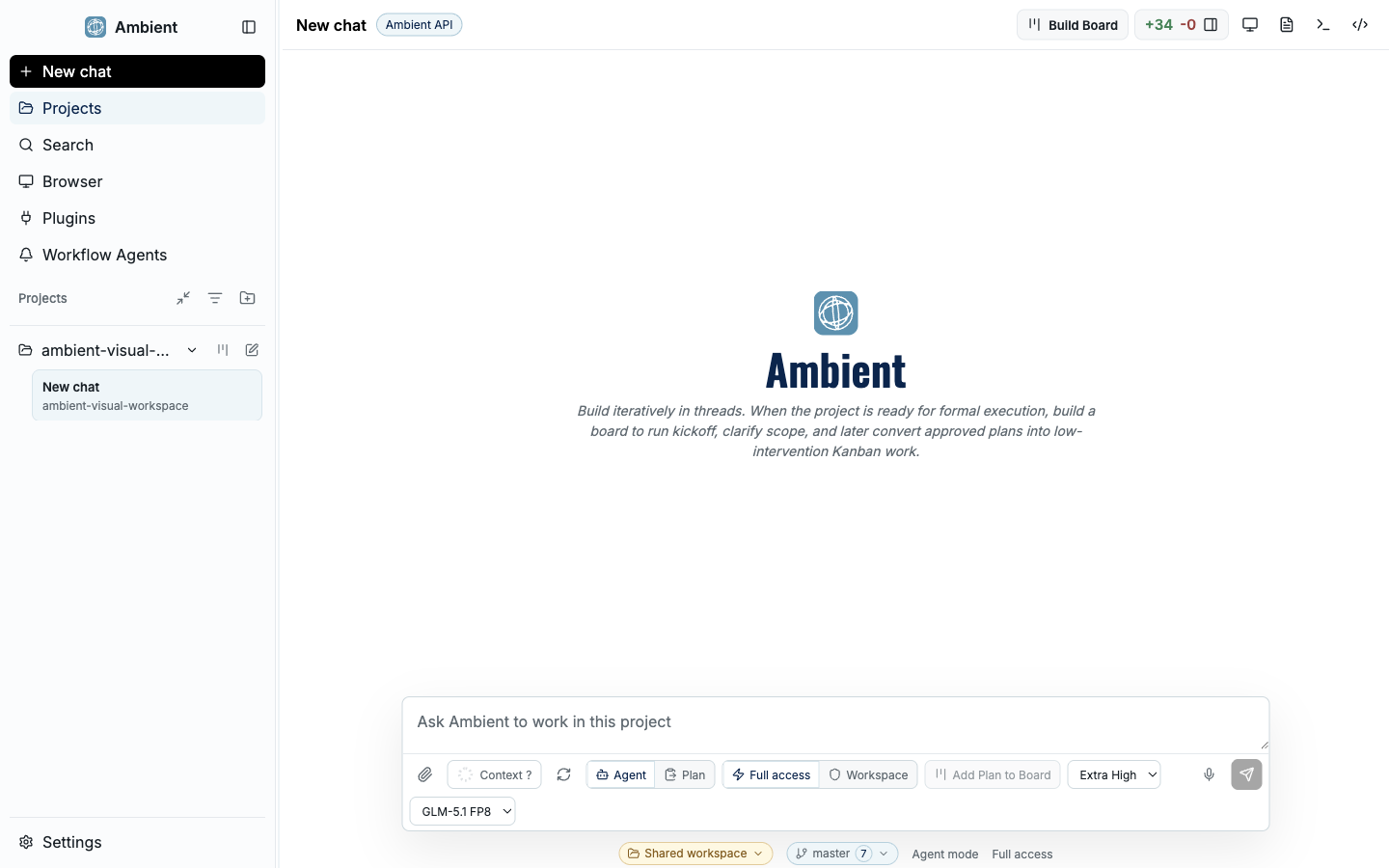
All four are surfaced through the same shell, which combines chat, workspace context, navigation, and evidence panels: chat, sidebar, and workspace controls in a single window.
The thesis#
Ambient Desktop is not only a coding agent. Coding is the first high-value application because it proves local agency, permissions, tools, browser evidence, artifact review, and workflow UX. The same primitives become the workstation for Ambient Network operations.
A developer should be able to move from code work to network work without changing mental models: inspect state, authorize capability use, capture evidence, route through the right provider, and preserve a durable record of what happened.
Four product surfaces#
Agentic Desktop#
Current and preview surfaces for coding, workflows, Project Board, browser evidence, Git review, and local artifact inspection.
Ambient Network Client#
The in-development first-party path for balances, embedded key flow, programs, transaction observation, Ambient L1 CLI integration, Tool Oracle, and x402 workflows. See Network client for what exists in the app today.
Ambient Mini Miner#
The roadmap mining surface for opt-in local Ambient Mini hosting, mineable machine state, routing eligibility, receipts, and network rewards. See Mini Miner.
Curated Capability Storefront#
The marketplace direction for reviewed Web2/Web3 technologies built on Ambient: MCPs, CLI packages, Pi tools, local runtimes, and finalized workflow artifacts. See Plugins and marketplace.
The routing fabric#
The critical product idea is vertical integration. Ambient Desktop does not treat local models, cloud models, plugins, browser providers, and network programs as isolated settings. They become a routing fabric that can choose the right capability for a task, fall back when needed, and preserve evidence of each decision.
- Local models provide privacy, latency, and opt-in mining foundations.
- Ambient provider calls provide high-capability reasoning and network-native behavior.
- Ambient Mini adds a local model network layer where eligible machines can earn network rewards.
- Curated plugins and CLI packages turn external services into permissioned capabilities.
- Project Board and workflow artifacts make the routing decisions visible to developers.
Maturity discipline#
This north star includes available product paths, developer-preview surfaces, in-development integrations, and roadmap commitments. The documentation labels those states explicitly so contributors know which pieces can be relied on today and which pieces still require implementation work. See Maturity labels for what each label means.
Keep going#
- Ambient Desktop: what the app is today (install, first session, and the shipped feature surfaces).
- What is Ambient: the network the workstation is being built onto.
- Network client: the same workstation that runs your code is growing into a first-party client for the Ambient Network: embedded keys, balances, programs, and transaction evidence, with the same inspect-everything posture as the rest of the app. This surface is in active development.
- Mini Miner: if your machine is already running local models, it could do useful work for the network when you are not. Ambient Mini mining is a planned, opt-in way to host a local model and earn network rewards when eligible.
- Plugins and marketplace: Ambient extends through plugins and capabilities, but every install has a visible class, permission profile, and uninstall path. The marketplace direction is curated and legible, not a raw feed of arbitrary executable code.