Ambient Desktop is the open agentic workstation: a local-first agentic workstation, model-orchestration engine, and miner. Run capable agents on your own machine, not a quarantined VM, with curated plugins, sandboxed capabilities, and inference from a credibly neutral, zero-data-retention network.
Open source (MIT) · runs locally on macOS, Windows, and Linux · ships with GLM 5.2 · v0.1.97 · Developer Preview.
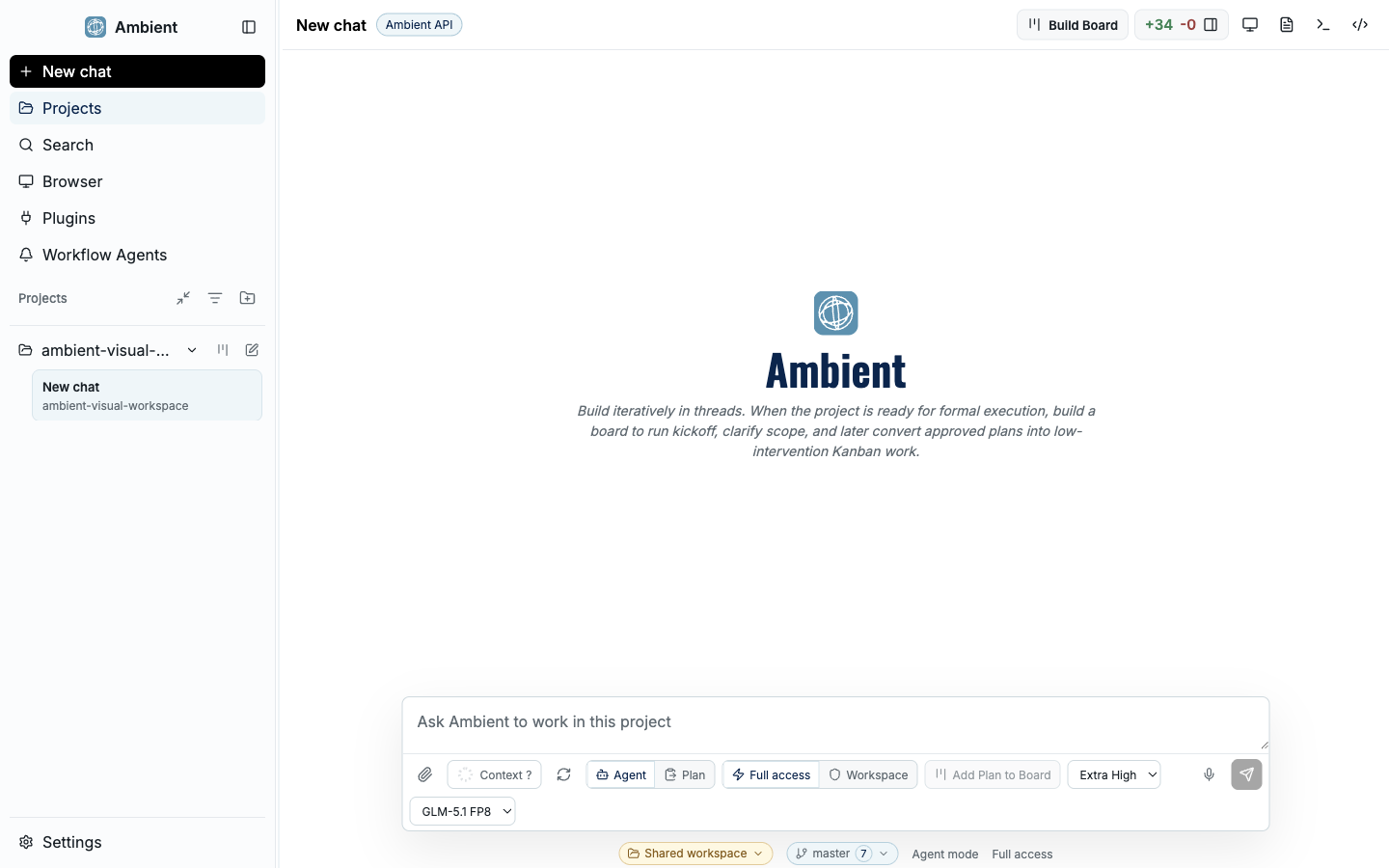
The shell itself combines chat, workspace context, navigation, and evidence panels in one local developer workstation: chat, sidebar, and workspace controls in a single window.
A workstation, not a chat wrapper#
Most agent tools hand you a chat box and a transcript. Ambient Desktop hands you a workspace. Agents operate on your real files, terminals, browsers, and source control, and every move shows up as something you can open and judge: a plan, a board card, an artifact, a screenshot, a validation command, a Git diff.
And it runs on your real machine, not a quarantined VM, because a security model that contains the risky capabilities instead of the whole agent means you do not have to choose between capable and safe. You stay the reviewer: pause, inspect the evidence behind any result, correct course, and resume without the agent losing the thread.
What makes Ambient different#
These are what separate Ambient from a coding copilot or a single-prompt agent. Each one exists because long-running, autonomous work needs structure, memory, and boundaries.
Project Board#
Durable, visible work. Large or ambiguous requests become a Kanban of source-backed cards with evidence, dependencies, and a review loop, not a transcript you have to scroll. Explore the Project Board.
Durable goals#
Survives restarts. Long-running goals persist their plan, evidence, and continuation state to disk, so work resumes from saved state instead of restarting from memory. How durable goals work.
Symphony orchestration#
More than one agent. A parent session delegates scoped work to specialist children (research, implementation, review, local-model) with budgets, approvals, and an artifact-driven join. See Symphony.
Contained capabilities#
Sandboxed by default. Risky tools (MCP servers, scrapers, Pi packages) run behind ToolHive containers and permission policy, so the agent can work on a normal desktop without blind trust. Read the security model.
Provider routing#
You pick the path. Search, fetch, browser, vision, local, and cloud providers are ordered by your preference and task fit, with visible fallback evidence when one is skipped. Provider routing.
Workflow Recorder#
Repeatable by design. Record a successful research or ops task once, then generalize it into a parameterized, callable workflow that runs like a reviewed tool. Record a workflow.
Open and yours#
Open by default. MIT-licensed harness, local-first, zero-data-retention inference. The code is open, your files stay on your machine, and the API keeps nothing. Bring your own models or use the network's. API and endpoints.
Frontier model, included#
Ambient ships with GLM 5.2, included and served from a credibly neutral, zero-data-retention network. Use it as your main agent and for sub-agents.
| Model | Role | What it is |
|---|---|---|
| GLM 5.2 | Default | The default model for Ambient Desktop (z-ai/glm-5.2), fast and capable, tuned for agentic coding and tool use. |
Kimi K2.7 Code (moonshotai/kimi-k2.7-code), previously offered as an
alternative, has been retired from the network and is no longer available.
Prefer your own tooling? The same model is available through Ambient's OpenAI-compatible API. See API and endpoints for the desktop's local endpoints, or the Ambient API quickstart for the network API.
Get started in three steps#
Install the app#
Download the signed build for macOS, Windows, or Linux, or build from source. First launch runs health checks for providers and runtimes. Installation guide.
Follow the Welcome Folder#
A pinned first-run project walks you through the shell, Core Setup, and Plugin Setup using the real product surfaces, not a sample repo. Open the Quickstart.
Run your first task#
Build a small calculator three ways (direct prompt, Planner-to-goal, and Planner-to-board) and inspect the proof behind each result. Three task paths.
Where the product is going#
Coding is the first high-value application because it exercises every hard part of agentic systems. But the destination is bigger: Ambient Desktop is the local front door to a network building intelligence as a global utility: a model-orchestration engine, a blockchain client, and the miner for the upcoming open season of Testnet mining. Below are the four surfaces and the routing fabric that ties them together; the product north star covers the same arc in detail, including how local models, network calls, plugins, and programs resolve into one routing fabric.
Ambient Desktop starts with high-value developer work and grows into the official workstation for the Ambient Network.
Ambient Desktop North Star diagram. The Ambient Desktop hub grows into the official workstation for the Ambient Network across four surfaces: Agentic Desktop (coding, workflows, browser evidence; Project Board and durable goals; stable tools plus preview workflows), Ambient Network Client (wallet, balances, programs; Tool Oracle and x402 direction; first-party blockchain workbench), Ambient Mini Miner (opt-in local model mining; llama.cpp runtime foundation; earn network rewards), and Curated Capability Storefront (reviewed Web2/Web3 capabilities; MCP, CLI, and Pi packages; permissioned install paths), all on one Vertically Integrated Routing Fabric spanning local models, Ambient cloud, Ambient Mini, plugins, browser providers, and network operations.
Agentic Desktop#
Developer Preview. The local-first coding and workflow surface: Project Board, durable goals, browser evidence, Git review, and artifact previews. This is what ships today.
Ambient Network Client#
In development. The first-party client for embedded key flow, balances, programs, transaction evidence, Tool Oracle, and x402, in active development. See Network client.
Ambient Mini Miner#
Roadmap. An opt-in surface to host a local model, mark a machine as mineable, and earn network rewards when eligible. On the roadmap, built on today's llama.cpp runtime. See Mini Miner.
Curated Capability Storefront#
Roadmap. A reviewed marketplace for Ambient-compatible Web2 and Web3 capabilities: MCP servers, CLI packages, Pi tools, and workflow artifacts. See Plugins and marketplace.
Honest about maturity#
Every page carries an explicit label (Available, Developer Preview, In Development, or Roadmap) so you always know what to rely on, what to test, and where implementation is still moving. These are operational signals, not marketing tiers. See Maturity labels for what each label means.
Run agents you can trust#
To run agents on your own machine with inference that keeps nothing, start with the Quickstart, or download Ambient Desktop for your platform.
Keep going#
- Quickstart: start in the Welcome Folder, finish setup, then run a small calculator task with visible proof.
- Project Board: turns goals into durable plans, task cards, source-backed evidence, and review loops.
- Security model: most agent tools protect you by sandboxing the whole agent, which also blinds it. Ambient does the opposite: the agent works on your real desktop, while the genuinely risky capabilities are the things that get contained.