Open-marketplace agent platforms (the OpenClaw model) win on raw breadth. Ambient optimizes for trustworthy defaults and bounded risk, and you can still add anything you want, deliberately. The Plugin Manager is where that shows up: curated defaults, install state, and each capability's trust boundary in one place.
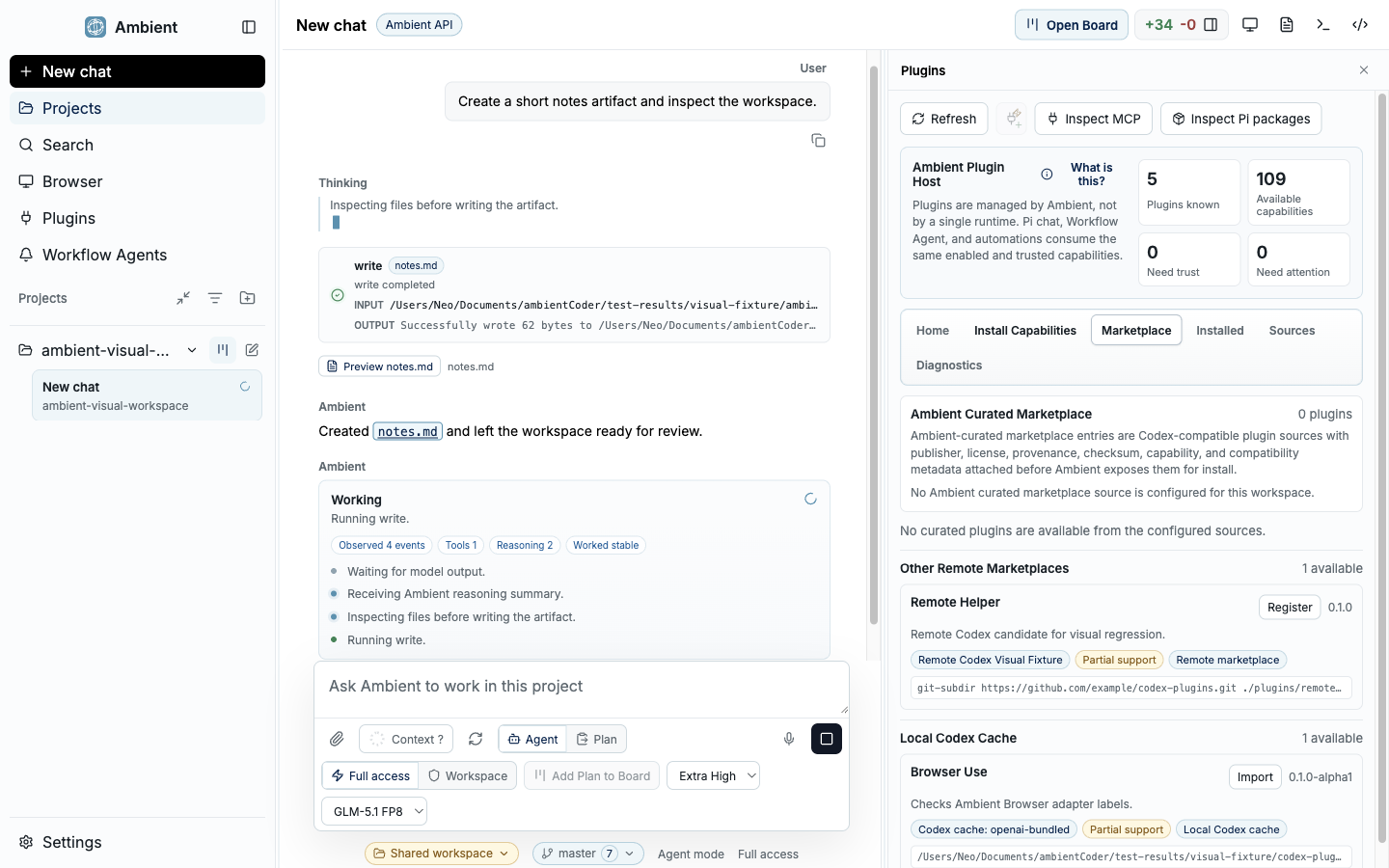
Breadth versus trust#
Open agent marketplaces (the OpenClaw model) let you install almost anything from a large community feed. That is powerful, and it is also where supply-chain risk lives: a single unreviewed plugin can read files, exfiltrate secrets, or drive a browser with your privileges.
Ambient takes the opposite default. Core capabilities come from a curated, reviewed, pinned set, and risky ones run inside containers behind permission policy. You give up nothing important: custom MCP servers, Pi packages, and your own capabilities are all still available. You just add them on purpose, with the trade-offs visible.
How the models compare#
| Dimension | Ambient Desktop | Open-marketplace agents |
|---|---|---|
| Default capabilities | Curated, reviewed, pinned defaults | Large open feed of community plugins |
| Supply-chain posture | Reputable upstreams, descriptor review, pinned runtimes | Install-anything; trust is on the user |
| Isolation | ToolHive containers + permission policy | Often runs with host or agent privileges |
| Secrets | Ambient-managed secret flow with redaction | Varies by plugin |
| Visibility | Install state, permissions, diagnostics, uninstall | Varies widely |
| Extending further | Add custom MCP, Pi tools, and built capabilities deliberately | Add from the open marketplace |
| Optimized for | Trustworthy defaults and bounded risk | Maximum breadth and novelty |
The honest trade-off#
If your priority is the widest possible catalog and you are comfortable vetting each addition yourself, an open marketplace will feel more expansive. If you want capabilities you can hand to an autonomous agent without auditing every line first, Ambient's curated-and-sandboxed default is the safer foundation, and it scales up as the curated catalog and Capability Builder grow.
Keep going#
- Curated defaults: the small set of reputable, reviewed, sandboxed capabilities that ship on by default
- Security model: how contained capabilities actually run
- Plugins and marketplace: the install classes, visible permission profiles, and the Capability Builder